
Keep Up with Addis Insight
Add us to your Google Preferred Sources to see updates first.
By-Selamawit Tezera
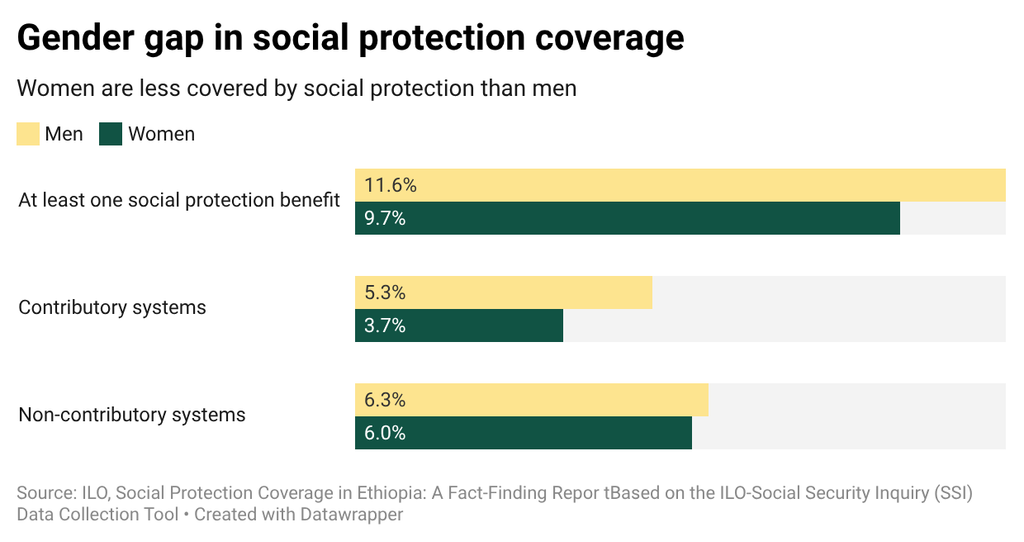
For decades, social protection has been framed as a tool for reducing poverty as a result of crises and helping households withstand economic shocks. In Ethiopia, programmes such as the Productive Safety Net Programme (PSNP), Community-Based Health Insurance (CBHI), school feeding and cash assistance have become important parts of the country’s social protection landscape. But there is another question that deserves closer attention: who is actually being protected through those schemes? The latest data from the International Labour Organization (ILO) shows that Ethiopia’s social protection system does not reach women and men equally. While 11.5% of the population is covered by at least one social protection benefit, coverage stands at 11.6% for men compared with only 9.7% for women. The figures point to a broader issue: social protection may be available in principle, but women’s unequal position in the economy shapes their ability to access and benefit from it.
The overall coverage figure also masks significant gaps in specific forms of protection. The ILO’s 2026 Social Protection Coverage in Ethiopia: A Fact-Finding Report finds that only 5.8% of the population receives cash social protection benefits. At the same time, CBHI has reached 40.1% of the population, and the School Feeding Programme reaches around 7.6 million children. These figures illustrate a system with considerable reach in some areas but much more limited coverage in direct income support.
Among people covered by contributory social protection systems, 5.3% are men compared with 3.7% of women. For non-contributory systems, coverage is closer, at 6.3% for men and 6% for women. The difference may look small in the second category; however, the wider pattern matters. Women are more likely to work in informal employment, unpaid family work, subsistence agriculture and other forms of work that provide limited access to contributory social insurance. A system that relies heavily on formal employment and contributions can therefore reproduce existing labour-market inequalities, even when its rules do not explicitly discriminate against women.
The gap becomes much more pronounced when reviewing protection across the life course. Only 1.8% of older women receive a pension, compared with 7.1% of older men. Among people with disabilities, 0.1% of women receive disability benefits compared with 0.5% of men. The gender gap is also visible among workers covered by a pension scheme, where coverage is 9% for women and 10.2% for men. These figures reflect the cumulative effect of unequal access to formal employment, income, assets and social insurance throughout women’s working lives.
Additionally, maternity protection reveals another important gap, with only 5.5% of women giving birth receiving maternity benefits. For women working outside formal employment, pregnancy can mean a loss of income without adequate income replacement or employment protection. This matters in a country where many women work in informal businesses, domestic work, and other forms of employment that do not provide the same social protections available to formal workers. Social protection is highly connected to formal employment; therefore risks leaving out those women whose livelihoods are often the most insecure.
There is one area where women have higher coverage; among the poor population receiving social assistance in cash, 2.5% of women are covered compared with 1.1% of men. This suggests that targeted social assistance can reach women when programmes deliberately identify poverty and vulnerability. But it also raises a deeper question: is reaching women enough if women continue to have less access to long-term social insurance and economic security? A woman may be successfully identified as a beneficiary while still having limited control over household resources, productive assets or decisions about how money is spent. From a feminist economics perspective, the measure of social protection should extend beyond the number of women enrolled to whether programmes increase women’s economic security and agency.
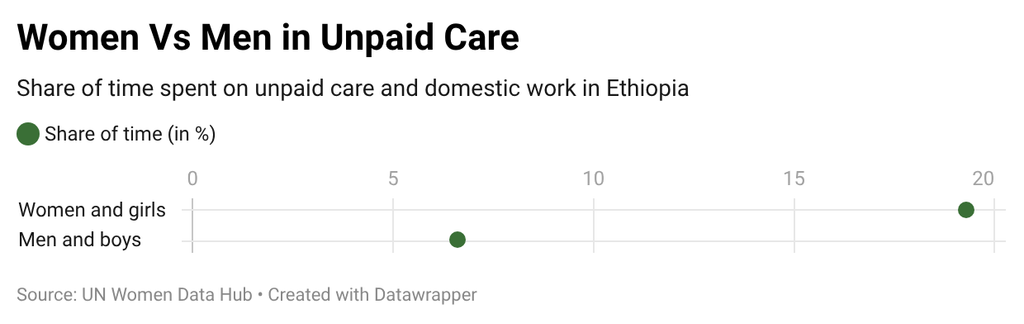
This is also where unpaid care work becomes central to understanding the gender gap. UN Women data show that Ethiopian women and girls spend 19.3% of their time on unpaid care and domestic work, compared with 6.6% for men. Caring for children, preparing meals, collecting water and fuel, and supporting older or sick family members are essential forms of labour, but they generally do not provide access to social security. Time spent outside paid employment can also reduce women’s ability to accumulate savings or build formal employment histories. The unpaid care economy and the social protection system are not separate issues; the work that women perform without pay can also leave them with less protection later in life.
The consequences accumulate over time. A woman who spends much of her working life combining unpaid care with informal employment or subsistence agriculture may have fewer opportunities to contribute to a pension system. The difference between 7.1% pension coverage among older men and just 1.8% among older women is not a gap that suddenly appears at retirement, it can be understood as the outcome of decades of unequal access to paid work, income and social insurance. This is why a feminist approach to social protection needs to consider the entire life course rather than treating poverty, maternity, disability and old age as separate policy issues.
Ethiopia has nevertheless built important foundations. The PSNP remains one of the country’s largest social protection programmes, and earlier phases incorporated measures intended to respond to women’s particular circumstances, including support for pregnant and lactating women and exemptions from labour-intensive public works. The newly approved PSNP 6 is expected to provide climate-smart public works for approximately 6 million people while supporting 700,000 people to establish or expand small businesses through training, mentoring and financial support, with women and young people identified as priority beneficiaries. This creates an opportunity to move from protecting households against immediate shocks towards strengthening women’s longer-term economic security.
But participation does not automatically mean empowerment. In some rural households, women may not be able to access or use cash transfers independently without their husband’s consent. Even when money is paid directly to a woman, household expectations may mean that she is expected to hand it to her husband or spend most of it on food and other immediate household needs. These expenditures are essential for household survival, but they can leave women with little control over resources that could otherwise strengthen their savings or productive activities. This distinction between receiving a benefit and having control over a benefit is critical. Social protection becomes transformative only when women are not simply counted as beneficiaries but have meaningful decision-making power over resources and greater control over their economic lives.
A stronger system requires Ethiopia to move beyond poverty targeting towards gender-responsive social protection across the life course. This means improving women’s access to pensions, disability benefits and maternity protection; extending social insurance to informal workers; investing in affordable childcare and services that reduce and redistribute unpaid care; and designing payment and grievance systems that women can use independently and safely. It also means learning from international experience. Rwanda, for example, has connected social protection with interventions around childcare and nutrition, while South Africa has used public employment programmes to recognize and remunerate forms of care work traditionally performed by women. Women’s rights advocates in Zimbabwe are pushing for the recognition of unpaid care work and for benefits to be incorporated under it. These experiences do not provide a blueprint for Ethiopia, but they demonstrate that social protection can be designed to address the economic structures behind gender inequality rather than simply responding to its consequences.
Rethinking social protection through Ethiopian women’s lives ultimately means changing what we count as protection. All the evidence shows that women are less likely than men to be covered by at least one social protection benefit and face especially large gaps in pensions and disability protection. At the same time, women’s unpaid care work continues to support households and the wider economy without providing them with corresponding economic security. Ethiopia has already established important foundations through programmes like PSNP and CBHI. The next step is to ensure that these systems do more than reach women: they should strengthen their income security, recognize the work they already contribute, reduce the unpaid care burden, and expand their control over resources. The real measure of a gender-responsive social protection system is not simply how many women it reaches, but whether women are more secure, more independent, and better able to shape their own economic futures.
This story was supported by Code for Africa’s WanaData initiative and the Digital Democracy Initiative as part of the Digitalise Youth project, funded by the European Partnership for Democracy (EPD) Code for Africa’s WanaData initiative

