Why Ethiopia’s 1964 Four-Dam Plan Failed — and Led to GERD

From Cascade to Colossus: The Strategic Evolution of Hydropower on Ethiopia’s Blue Nile
Executive Summary
In the 1960s, engineers mapped a four-dam cascade—Karadobi, Mabil, Mendaia, Border—to turn the Blue Nile’s violent seasonality into steady power, flood control, and sediment management. The plan stalled for decades due to downstream veto politics embedded in international finance rules. Ethiopia pivoted: build one huge dam at the border with Sudan, finance it domestically, move fast, and create irreversible facts. That dam—GERD—is now complete and preparing for inauguration, reshaping negotiations from whether a dam can exist to how it should be operated.
I. The 1964 Blueprint: How the Cascade Was Meant to Work
The USBR master plan (1956–1964) integrated hydrology, geomorphology, and power-system planning. It sequenced four dams so that upstream storage captured the short, intense rainy-season flows (≈70% in four months) and released them predictably through the dry season. The cascade also aimed to intercept the Ethiopian Highlands’ heavy sediment load before it damaged downstream assets.
| Project | Position | Proposed MW | Reservoir (BCM) | Primary Purpose |
|---|---|---|---|---|
| Karadobi | Upstream (1) | 1,350–1,600 | ≈32.5 | Hydropower, major flow regulation, sediment trapping |
| Mabil | Midstream (2) | ≈1,200 | ≈13.6 | Hydropower |
| Mendaia | Midstream (3) | 1,620–2,000 | ≈15.9 | Hydropower, irrigation support |
| Border | Terminal (4) | 1,200–1,400 | ≈11.1 | Hydropower, irrigation support |
II. The Studies That Shaped the Plans (Methods, Dates, What They Proved)
1) USBR Master Plan (1956–1964): Fieldwork → Models → Sites
- Methods: basin mapping, gauge analysis, sediment sampling, aerial photogrammetry (1:50k–1:250k), flow duration & flood frequency, preliminary geotech.
- Outputs: four main-stem sites; basin irrigable area ≈433,000 ha; power potential up to ≈8,660 MW (multi-project total across options).
- Operating concept: “run-of-cascade” with shared rule curves so releases stack benefits downstream.
2) Nordic-Backed Prefeasibility/Feasibility (2000s): Reality Checks
- Karadobi: updated hydrology, sediment yield, RCC vs CFRD concepts, diversion works, preliminary E&S scoping; indicative ~1,600 MW.
- Mendaia (Mandaya): spillway PMF sizing, sediment routing scenarios, heritage corridor screening, stepped resettlement planning; indicative ~2,000 MW.
- Bottom line: technically viable; bottleneck was bankability under transboundary financing rules.
3) Nile Basin Initiative & CFA: The Cooperation That Didn’t Land
- Goal: move lenders from water-allocation disputes to benefit-sharing projects.
- Stall point: refusal to adopt the CFA left lenders requiring downstream “no-objection,” keeping the veto alive.
4) GERD Pivot: Why One Big Dam
- Site continuity: uses the historic “Border” location; scales storage to inter-annual levels.
- Strategy: domestic financing avoids IFI veto; single operator reduces coordination risks; speed changes bargaining power.
- Operating idea: GERD as a geopolitical battery—firm national load, enable exports, and negotiate seasonal release windows.
III. Geopolitics & Finance: How a Veto Became “The Plan”
Colonial-era allocations (1929, 1959) were never signed by Ethiopia but shaped lender policies requiring downstream consent for transboundary projects. That converted Egypt’s political position into a financing tool. The result: technically sound cascade sites were frozen. After failed multilateral fixes, Ethiopia reframed the problem as one of sovereignty and speed.
IV. GERD: Design, Timeline, Scale, Finance
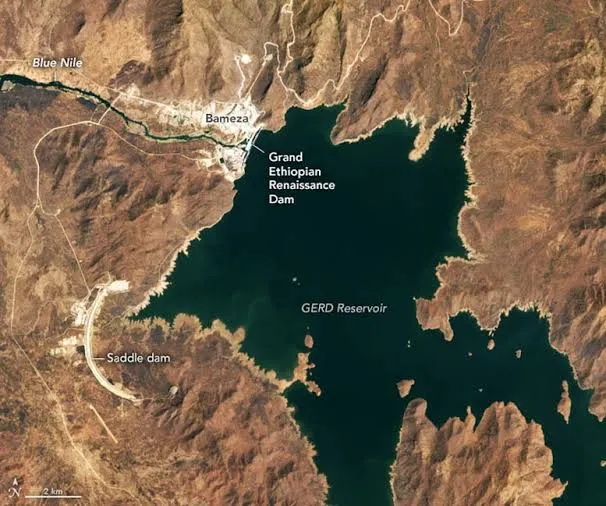
Type: RCC gravity dam (~145 m tall, ~1.8 km crest) + saddle dam; 13 Francis units; gated spillways; low-level outlets for drawdown/flush windows.
- 2011: Construction launched as national project.
- 2020–2023: Phased filling to ~74 BCM (multi-wet-season approach).
- 2022: First power to grid; progressive turbine commissioning.
- 2025: Construction completion announced; inauguration slated for September.
Hydrology: ~74 BCM storage ≈ ~1.5 years of mean Blue Nile flow at the border; enables inter-annual buffering during drought sequences.
Funding: domestic budget, diaspora/public bonds, payroll contributions; EPC tranches; FX prioritization for electromechanical packages.

| Project | Status | MW | Reservoir | Funding |
|---|---|---|---|---|
| Karadobi | Shelved (viable) | ≈1,600 | ≈32.5 BCM | IFI/International (envisioned) |
| Mendaia | Postponed; PPP sought | ≈2,000 | ≈15.9 BCM | PPP (planned) |
| GERD | Complete; inauguration Sept 2025 | 5,150 | ≈74 BCM | Domestic / public bonds |
V. Operations: Cascade vs Single Colossus
Firm Energy & Flexibility
- Cascade: higher firm output by stacking storage across elevations; hydropower dispatch spread across units reduces single-point maintenance outages.
- GERD: comparable energy scale with centralized dispatch; excellent ramping headroom for grid balancing and export contracts.
Sediment & Asset Life
- Cascade: progressive trapping; lower sediment stress per reservoir; higher total capex and operations complexity.
- GERD: near-total trapping at one site—good for downstream lifespans; requires long-horizon dead-storage planning, periodic drawdown/sluice windows, and adaptive rules.
Drought Management & Rule Curves
- Cascade: multiple control points permit targeted seasonal shaping.
- GERD: inter-annual buffer allows calibrated releases through multi-year droughts; coordination with Sudanese reservoirs reduces combined risk.
System Risk
- Cascade risk: distributed mechanical risk, but higher scheduling/coordination risk and more transmission miles.
- Single-dam risk: concentrated physical risk; mitigated by redundancy in units, robust dam safety program, and emergency drawdown capability.
VI. Environmental & Social Ledger (ESIA Themes)
People
- Resettlement for reservoir footprint; livelihood transition programs (agriculture to services/fisheries/forestry).
- Benefit pathways: electrification for households/industry, health/education access, women’s time savings from cleaner energy.
River & Ecosystems
- Sediment trapping extends downstream reservoir life but alters floodplain nutrients; possible “hungry water” channel adjustments.
- Reservoir limnology: temperature/oxygen stratification; initial GHG pulse from biomass decomposition; fisheries transition to lacustrine species.
- Dam safety: fault systems, reservoir-induced seismicity; landslide surveillance on steep banks; early-warning & wave run-up analysis for slides.
VII. Finance After GERD: PPP Playbook for Karadobi & Mendaia
Bankability Checklist
- Legal: mature PPP law, transparent procurement, sovereign support letter, step-in rights for lenders.
- Revenue: long-term take-or-pay PPAs (domestic + cross-border), indexed tariffs, curtailment clauses.
- Risk: hydrology variability buffers, FX convertibility, political risk insurance (MIGA-type), construction risk allocation EPC-turnkey.
- ESG: lender-grade ESIA, grievance mechanisms, livelihood restoration with M&E, biodiversity offsets where relevant.
Capital Stack Options
- Debt: DFI syndicates, export credit for turbines/generators/gates, green bonds.
- Equity: strategic utilities, infrastructure funds, pension capital, sovereign co-investment.
- Blends: viability gap grants, results-based disbursements, carbon revenue adders for peaking thermal displacement.
VIII. Grid Integration & Regional Exports
GERD’s large, controllable output supports frequency regulation and peak shaving domestically. Regionally, firm export blocks depend on seasonal release envelopes and intertie capacity. Coordination with Sudan’s Roseires/Sennar/Merowe and Egypt’s HAD operations can reduce total spill and improve combined reliability.
Priority Actions
- Finalize interconnection upgrades (HV capacity and N-1 security).
- Standardize regional grid codes and scheduling protocols.
- Structure PPAs with clear hydrology-linked availability bands.
- Publish quarterly hydrology/operations bulletins to build trust and market confidence.
IX. Scenarios & Timelines (Illustrative)
| Scenario | 2025–27 | 2028–31 | 2032–35 | Notes |
|---|---|---|---|---|
| Base | GERD O&M optimization; export PPAs pilot | Mendaia PPP reach FC; early works | Mendaia commissioning | Focus on grid stability & tariff reform |
| Accelerated | PPP framework & guarantees in place | Mendaia + Karadobi parallel EPC | Two-dam cascade with GERD | Requires strong FX and DFI anchor |
| Cautious | Only prep studies; no FC | Selective early works | Slip to late 2030s | Fiscal/inflation constraints binding |
X. FAQ
Why didn’t Ethiopia just build the four-dam cascade?
Because lender policies required downstream “no-objection,” effectively granting a veto. The cascade was sound on engineering, unbankable in practice.
Is GERD complete and when is the inauguration?
Yes—construction completion was announced in 2025; inauguration is slated for September 2025.
Are Karadobi and Mendaia still viable?
Yes—as PPPs with bankable PPAs, credible ESIA, and staged transmission. GERD makes the politics manageable; the challenge is now finance and delivery.

About Addis Insight
Addis Insight is Ethiopia’s fastest growing digital news platform, providing consumers with the latest news from Ethiopia and its diaspora. We provide marketers with innovative opportunities to leverage our stories and overall brand with a fiercely curious and highly engaged audience.