ARA-290: Cytoprotection, Neuroimmune Signaling, and Systems-Level Regulation

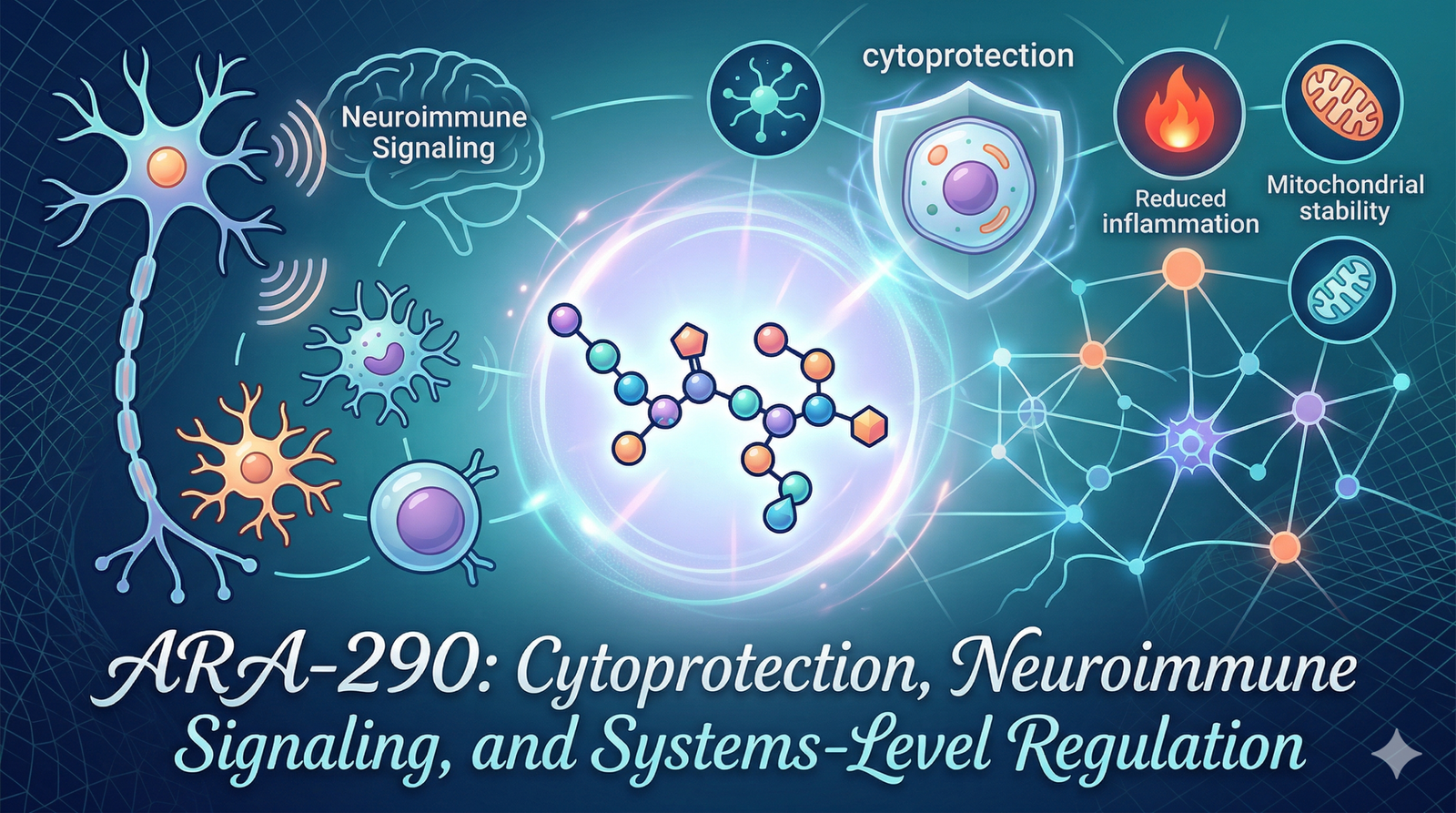
Within peptide research, certain molecular sequences attract attention not because of their size or complexity, but because of their strategic positioning within larger biological narratives. ARA-290 belongs to this category. Derived conceptually from erythropoietin-related signaling motifs, ARA-290 represents a refined peptide construct designed to engage selective receptor pathways without invoking the full functional spectrum of its parent hormone. Research interest has increasingly reframed this peptide as an informational regulator—one that may support cellular communication, stress response coordination, and neuroimmune balance at a systems level.
Structural Identity and Conceptual Origins
ARA-290 is a short synthetic peptide inspired by a non-erythropoietic region of the erythropoietin molecule. Unlike full-length erythropoietin, which engages classical homodimeric receptors associated with erythropoiesis, ARA-290 has been designed to preferentially interact with an alternative receptor complex often described as a heteromeric assembly involving innate immune signaling components.
Research indicates that this receptor preference is central to the peptide’s theoretical profile. By bypassing pathways linked to cellular proliferation and hematopoietic signaling, ARA-290 has been hypothesized to engage cytoprotective and modulatory cascades with reduced systemic activation. This selective signaling paradigm has positioned the peptide as a tool for dissecting how truncated sequences may retain informational potential while avoiding broader hormonal programming.
Receptor Interaction and Signaling Bias
Central to the scientific discussion around ARA-290 is the concept of receptor bias. Research suggests that the peptide may preferentially activate signaling pathways associated with cellular resilience rather than growth or differentiation. Investigations purport that engagement of alternative erythropoietin-related receptor complexes may initiate intracellular cascades involving anti-inflammatory signaling, redox balance regulation, and mitochondrial stability.
Rather than triggering broad transcriptional programs, ARA-290 has been theorized to exert a modulatory suport by subtly supporting kinase activity, transcription factor localization, and cytokine signaling thresholds. This kind of signaling bias aligns with contemporary systems biology models, which emphasize modulation over activation and coordination over amplification.
Neuroimmune Interface and Sensory Signaling
One of the most discussed research avenues involving ARA-290 relates to the neuroimmune interface. Research indicates that erythropoietin-derived peptides may play a role in how neural and immune systems exchange information, particularly in contexts involving sensory processing and inflammatory signaling.
ARA-290 has been hypothesized to support glial-immune communication, potentially modulating how immune-derived signals are interpreted within neural tissue. Investigations purport that the peptide might alter the sensitivity of neural circuits to inflammatory mediators, thereby shaping perception, signal integration, and adaptive responses.
Cytoprotection and Cellular Stress Coordination
Another prominent research theme surrounding ARA-290 is believed to involve cytoprotection. Research indicates that erythropoietin-related signaling is deeply intertwined with cellular survival pathways, particularly under conditions of metabolic or oxidative stress. ARA-290, by selectively engaging non-erythropoietic receptors, has been theorized to preserve this protective dimension while minimizing unrelated signaling.
Investigations purport that the peptide may support mitochondrial integrity, redox signaling, and apoptosis-related checkpoints. Rather than acting as a direct antioxidant, ARA-290 seems to coordinate endogenous stress response systems, encouraging cells to adapt more efficiently to adverse conditions.
Inflammatory Signaling and Immune Modulation Research
Inflammatory regulation represents another key area of theoretical interest. Research suggests that ARA-290 may interact with innate immune signaling pathways, potentially influencing cytokine release patterns and immune cell activation thresholds. Rather than suppressing immune activity, the peptide has been hypothesized to promote balance—reducing excessive signaling while preserving essential defensive functions.
Investigations purport that this balancing role may prove to be particularly relevant in chronic inflammatory contexts, where persistent low-level signaling disrupts tissue homeostasis. By modulating receptor-level communication, ARA-290 may help elucidate how immune systems transition between active defense and resolution phases.
Metabolic and Vascular Considerations
Beyond neural and immune domains, ARA-290 has also been discussed in relation to metabolic and vascular signaling. Research indicates that erythropoietin-related pathways might intersect with endothelial function, nitric oxide signaling, and metabolic regulation. ARA-290, by engaging selective receptor complexes, has been theorized to support these systems indirectly.
Investigations purport that the peptide might affect microvascular signaling, cellular energy sensing, and nutrient-response coordination. Such supports may be relevant for research exploring ischemic stress, metabolic dysregulation, and tissue perfusion dynamics—areas where cellular communication plays a decisive role.
ARA-290 in Systems Biology and Network Science
From a systems biology perspective, ARA-290 represents an example of how minimal peptides might exert disproportionate influence by targeting network hubs rather than isolated pathways. Research indicates that small signaling fragments may act as nodal regulators, influencing multiple downstream systems through modest upstream adjustments.
Investigations purport that ARA-290’s relevance lies in its potential to integrate signals across immune, neural, and metabolic networks. This integrative potential is believed to align with the principles of network science, which emphasize the importance of interconnectivity, feedback loops, and emergent behavior within biological systems.
Conclusion
ARA-290 occupies a distinctive niche within contemporary peptide research. Rooted in erythropoietin biology yet reimagined as a minimalist signaling fragment, the peptide exemplifies a shift toward precision modulation and systems awareness. Research indicates that its properties may extend across neuroimmune communication, cytoprotection, inflammatory balance, and metabolic coordination. Click here for the best research peptides.
References
[i] Brines, M., Grasso, G., Fiordaliso, F., Sfacteria, A., Ghezzi, P., Fratelli, M., … Cerami, A. (2004). Erythropoietin mediates tissue protection through an erythropoietin and common β-subunit heteroreceptor. Proceedings of the National Academy of Sciences of the United States of America, 101(41), 14907–14912. https://doi.org/10.1073/pnas.040649110
[ii] Brines, M., Patel, N. S. A., Villa, P., Brines, C., Mennini, T., De Paola, M., … Cerami, A. (2008). Nonerythropoietic, tissue-protective peptides derived from the tertiary structure of erythropoietin. Proceedings of the National Academy of Sciences of the United States of America, 105(31), 10925–10930. https://doi.org/10.1073/pnas.0805594105
[iii] Swartjes, M., Morariu, A., Niesters, M., Brines, M., Cerami, A., Aarts, L., & Dahan, A. (2011). ARA 290, a nonerythropoietic erythropoietin analog, reduces neuropathic pain and inflammation. Pain, 152(7), 1659–1668. https://doi.org/10.1016/j.pain.2011.03.020
[iv] Brines, M., & Cerami, A. (2012). The receptor that tames the innate immune response. Molecular Medicine, 18(1), 486–496. https://doi.org/10.2119/molmed.2011.00437
[v] Leist, M., Ghezzi, P., Grasso, G., Bianchi, R., Villa, P., Fratelli, M., … Brines, M. (2004). Derivatives of erythropoietin that are tissue protective but not erythropoietic. Science, 305(5681), 239–242. https://doi.org/10.1126/science.1098313

About Addis Insight
Addis Insight is Ethiopia’s fastest growing digital news platform, providing consumers with the latest news from Ethiopia and its diaspora. We provide marketers with innovative opportunities to leverage our stories and overall brand with a fiercely curious and highly engaged audience.