
Keep Up with Addis Insight
Add us to your Google Preferred Sources to see updates first.
Women’s economic empowerment is frequently celebrated as a cornerstone of Ethiopia’s development ambitions. Across the country, women cultivate farms, run small businesses, sustain informal markets, and shoulder much of the unpaid care that keeps households and communities functioning. Yet despite being central to the economy, women continue to face unequal access to one of its most powerful resources: finance. The inability to save securely, access affordable credit, or invest in business growth is not simply an individual challenge. It reflects structural inequalities that continue to shape whose economic contributions are recognized, valued, and financed.
Recent evidence from the National Bank of Ethiopia (NBE) demonstrates that while women’s financial inclusion is improving, financial equality remains out of reach. Although the 2026 Women’s Financial Inclusion Scorecard, covering all 32 commercial banks, shows encouraging progress in expanding services for women, the data also reveal that women continue to participate in the financial system on unequal terms. They are less likely to use financial services actively, receive substantially smaller loans than men, and remain largely absent from the institutions that make financial decisions. These disparities matter because finance is more than money. It determines who can start a business, withstand economic shocks, build assets, and shape their own economic future.
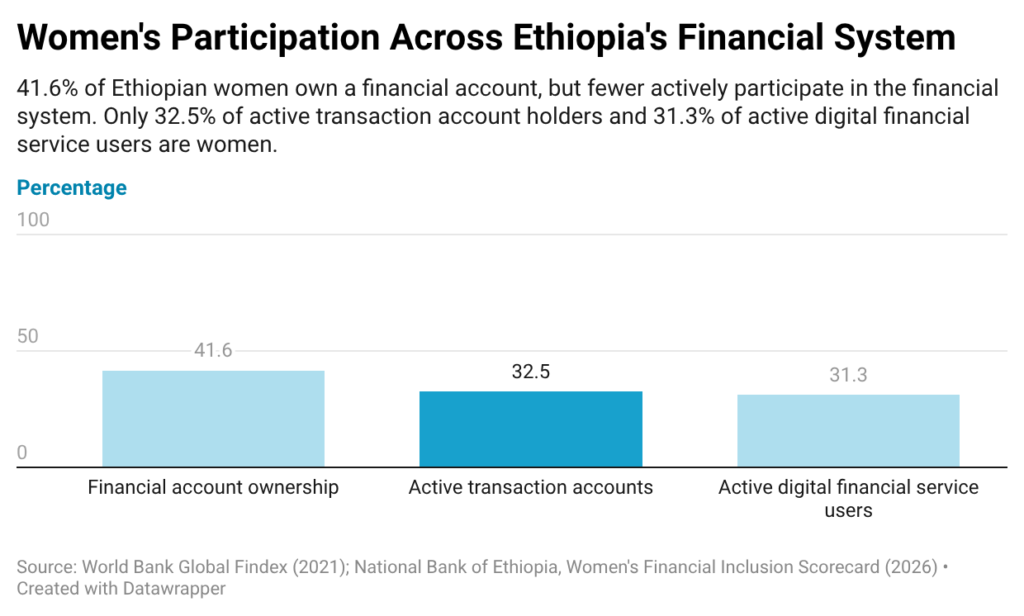
The exclusion begins with access. According to the World Bank Global Findex, 41.6 percent of Ethiopian women own a formal financial account compared to 56.5 percent of men, leaving a gender gap of nearly 15 percentage points. But ownership alone tells only part of the story. The National Bank’s Scorecard shows that women account for just 32.5 percent of active transaction account holders and 31.3 percent of active digital financial service users, both well below the regulator’s target of 50 percent. These figures suggest that women are entering the financial system but are not participating in it at the same pace as men. Having an account is not the same as having financial power.
The gender gap becomes even more pronounced when women attempt to grow businesses. Entrepreneurship is often portrayed as a pathway to women’s empowerment, yet the resources needed to build successful enterprises remain unevenly distributed. ActionAid Ethiopia reports that only 24 percent of Ethiopian women are self-employed compared to 54 percent of men, which highlights structural barriers that extend far beyond individual ambition. Women’s enterprises are frequently concentrated in lower-return sectors, constrained by limited assets, and shaped by unequal access to markets, networks, and finance.
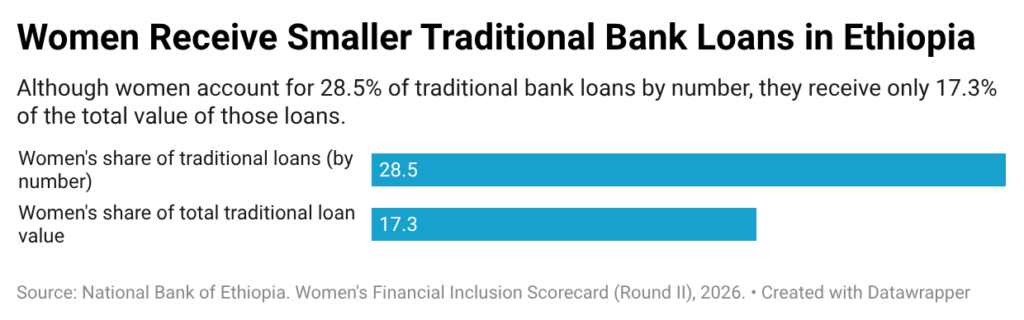
Credit is where these inequalities become most visible. According to the National Bank of Ethiopia, women receive 28.5 percent of traditional bank loans by number, suggesting that more women are beginning to access formal credit. However, they receive only 17.3 percent of the total value of those loans. This distinction is critical. Women are increasingly counted as borrowers, yet they continue to receive substantially smaller investments than men. Smaller loans often mean smaller businesses, slower growth, lower productivity, and fewer opportunities to employ others. Measuring access without examining the size and quality of finance risks masking deeper inequalities within the financial system.
This financing gap is not accidental. It reflects broader gendered inequalities in ownership of land, housing, and productive assets that banks typically require as collateral. It also reflects social norms that have historically limited women’s control over wealth and financial decision-making. Development practitioners describe this as the “missing middle”: women entrepreneurs have grown beyond the small loans available through microfinance institutions but remain excluded from commercial lending because they lack the collateral demanded by banks. In practice, many women are considered entrepreneurial enough to sustain families but not bankable enough to receive meaningful investment.
The consequences extend far beyond individual businesses. Previous studies on women’s economic participation in Ethiopia have consistently shown that women spend significantly more time on unpaid care and domestic work than men. Caring for children, elderly family members, and households continues to fall disproportionately on women, limiting the time available to pursue training, manage businesses, visit financial institutions, or build professional networks. Feminist economists have long argued that economies depend upon this invisible labour while systematically failing to recognize or reward it. Financial exclusion therefore cannot be understood separately from unpaid care work. The same gender norms that assign women responsibility for care also shape their access to capital, assets, and economic opportunity.
Evidence from the World Bank’s Women Entrepreneurship Development Project (WEDP) demonstrates that these barriers are neither inevitable nor irreversible. Women entrepreneurs who received access to finance alongside business development support expanded their businesses, increased profits, created employment, and strengthened productivity. The results challenge persistent stereotypes that women-owned enterprises are inherently smaller or less profitable. Rather, they show that when structural barriers are removed, women invest, innovate, and contribute substantially to economic growth.
The financial sector itself also reflects persistent gender inequalities. Women comprise 32.1 percent of employees across Ethiopia’s banking industry, yet hold only 14.8 percent of senior management positions. Although 71.9 percent of commercial banks have achieved the National Bank’s requirement of appointing at least two women to their boards, leadership remains overwhelmingly male. This matters because financial institutions are not gender-neutral. Decisions about lending criteria, product design, digital innovation, customer outreach, and risk assessment are shaped by those who hold power within these institutions. Greater representation of women in financial leadership is therefore not simply a question of workplace equality but of creating financial systems that better reflect the realities of women clients.
At the same time, the Scorecard offers reasons for cautious optimism. Nearly 47.6 percent of innovative lending products introduced by participating banks are specifically designed to serve women, exceeding the National Bank’s benchmark of 30 percent. This signals growing recognition that women are not a niche market but a major economic constituency whose financial needs deserve dedicated investment. Yet innovation alone is insufficient if women continue receiving smaller loans, lower-value investments, and fewer opportunities to scale their businesses. The conversation must move beyond financial inclusion toward financial justice. Opening more bank accounts or increasing the number of women borrowers will not, by themselves, dismantle structural inequalities that shape women’s economic lives.
Meaningful progress requires financial systems that recognize the realities of unpaid care work, unequal asset ownership, digital exclusion, and discriminatory lending practices. It requires gender-responsive financial products, collateral alternatives, stronger investment in women-owned enterprises, greater representation of women in financial leadership, and policies that treat women not as beneficiaries of development but as economic actors whose labour already sustains households, markets, and the national economy.
Closing the gender gap in access to finance is not simply about expanding banking services. It is about redistributing economic opportunity, recognizing women’s productive and reproductive labour, and building a financial system that values women’s work as much as it depends on it. When women gain equal access to capital, the benefits extend far beyond individual entrepreneurs.
This story was supported by Code for Africa’s WanaData initiative and the Digital Democracy Initiative as part of the Digitalise Youth project, funded by the European Partnership for Democracy (EPD) Code for Africa’s WanaData initiative

