The Complex and Evolving Trends of Ethiopian Migration: An In-Depth Exploration

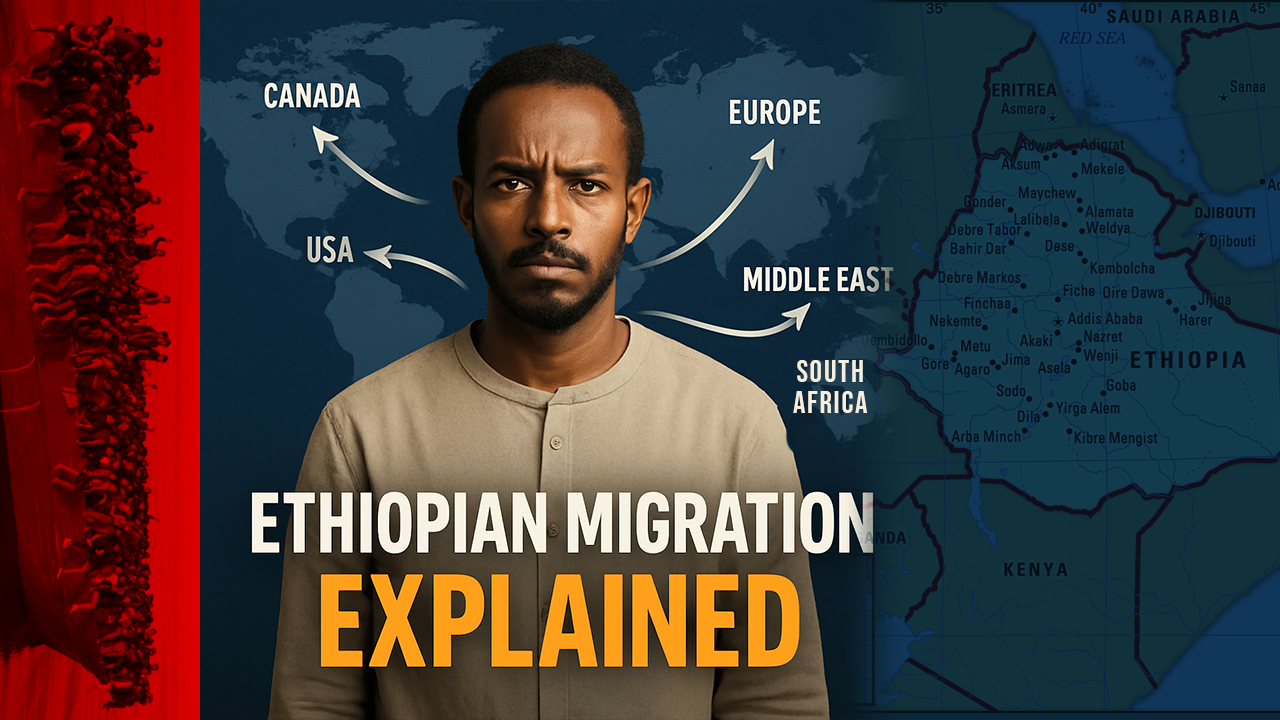
Ethiopia’s migration patterns have been shaped by a combination of political, social, economic, and environmental factors, both past and present, with approximately 250,000 Ethiopians migrating annually. Over the decades, Ethiopians have moved within their borders, across the region, and internationally—seeking better opportunities, refuge from political instability, or simply escaping harsh living conditions. Today, Ethiopian migration continues to evolve, presenting new challenges and opportunities, particularly as people seek labor abroad or flee conflict.
Pre-20th Century: Internal Movement and Regional Connections
Historically, Ethiopian migration was predominantly internal, with diverse ethnic groups engaging in seasonal movements for agriculture, trade, and pastoralism. Such internal mobility has long been a characteristic of Ethiopian society.
Additionally, Ethiopia’s strategic location near the Red Sea facilitated regional interactions. Ethiopians participated in trade, religious pilgrimages, and cultural exchanges with neighboring regions, including the Arabian Peninsula, Sudan, and Egypt. These movements contributed to the rich tapestry of cultural and economic ties in the Horn of Africa.
Early to Mid-20th Century: The Rise of International Migration
The country experienced extreme political turmoil, recurrent droughts, famine, and devastating civil war. Since the mid-1960s, Ethiopia has witnessed major droughts and famines, often met with compulsory internal resettlement and “villagization” programs that relocated rural communities.
In the 20th century, international migration from Ethiopia became more pronounced. Ethiopian students and intellectuals sought educational opportunities abroad, particularly in the United States and Europe. Emperor Haile Selassie’s government supported many students to study in Western countries, fostering the establishment of Ethiopian diaspora communities in cities like Washington, D.C., and Los Angeles.
During Haile Selassie’s rule (beginning in 1930), emigration was minimal, primarily involving urban elites seeking education abroad. Between 1941 and 1974, approximately 20,000 Ethiopians left as students and diplomats, according to the Migration Policy Institute. Most returned to assume government roles, while refugee numbers remained low due to relative stability, despite political repression.
The Derg Era (1974–1991): Political Unrest and Mass Exodus
The overthrow of Emperor Haile Selassie in 1974 and the rise of the Derg military regime marked a significant turning point in Ethiopia’s migration history. Two months later, the government executed dozens of political opponents, triggering a new wave of emigration. The Qey Shibir campaign led to a civil war that lasted until the Derg’s fall in 1991. This period also overlapped with the mid-1980s famine, which caused over a million deaths. Ethiopia’s war with Somalia in the Ogaden (1977–1978) further intensified mass displacement. By 1980, over 2.5 million Ethiopians had been forcibly displaced, many seeking refuge in Sudan and Kenya, with others resettling in Western countries such as the U.S., Europe, and Australia.
The mid-1980s famine further worsened the crisis. The international community’s response, coupled with the oppressive political climate, prompted many Ethiopians to migrate to Europe, North America, and the Middle East. The U.S., in particular, became a primary destination, with significant Ethiopian communities forming in cities like Washington, D.C., and Los Angeles.
Post-Derg Period (1991–Present): New Challenges and Shifting Patterns
Following the fall of the Derg in 1991 and the establishment of the Ethiopian People’s Revolutionary Democratic Front (EPRDF), Ethiopia entered a period of political stability, enabling the return of over 970,000 refugees from neighboring countries. However, economic challenges, including high unemployment and poverty, spurred new migration trends.
In the early 2000s, many Ethiopians began migrating to the Middle East—particularly to Saudi Arabia and the United Arab Emirates—for work in domestic service, construction, and hospitality. While migrants send remittances home, they often face exploitative labor conditions and abuse.
Ethiopia as a Host Country
In contrast to its role as a source country, Ethiopia has increasingly become a destination for refugees fleeing conflict and instability in neighboring nations. Ethiopia currently hosts refugees from South Sudan, Eritrea, and Somalia. With over 900,000 refugees, it is one of Africa’s largest refugee-hosting countries. These populations often live in camps or urban areas with limited access to resources.
According to the UNHCR 2025 report, Ethiopia hosts a total of 1,075,079 refugees and asylum seekers, including 1,011,585 refugees and 63,494 asylum seekers. Women make up 52% of this population, and men 48%. The majority come from South Sudan (40%), followed by Somalia (34%), Eritrea (17%), and Sudan (9%).
Recent Trends: 2015–2025
Migration has surged since 2015, with an estimated 839,000 Ethiopians migrating abroad between 2015 and 2020. The International Organization for Migration (IOM) reports that most were aged 15 to 29. About 31% migrated to Saudi Arabia, while others went to South Africa, the UAE, the U.S., and Yemen, primarily for low-skilled work in domestic labor, construction, and agriculture.
These trends were fueled by high unemployment and limited economic opportunities, as well as political instability and regional conflicts—including the 2018 Tigray war—which led to the internal displacement of over 1.8 million people by 2020.
According to the World Population Review 2025, Virginia has the largest Ethiopian population at 38,394 (0.44%), followed by Maryland with 34,566 (0.56%). California (36,527), Minnesota (26,926), and Washington (25,937) also have large Ethiopian communities. The District of Columbia has the highest concentration (0.99%), while Arkansas has the lowest with only 49 people (0.002%).
Emerging Migration Trends: Youth and Irregular Migration
Recent migration is increasingly youth-driven, motivated by economic hardship, educational aspirations, and escape from political or social instability.
One alarming trend is the rise of irregular migration routes through the Red Sea and the Sahara. Migrants attempting to reach the Gulf States or Europe face grave dangers, including trafficking, abuse, and death. Many Ethiopians travel to Libya hoping to cross to Europe via dangerous boat routes.
A Dangerous Journey: The Eastern Corridor
The eastern migration corridor—through Djibouti, Yemen, and into Saudi Arabia—is among the fastest-growing and most dangerous in the world. Thousands of Ethiopians attempt this route each year, often facing kidnapping, abuse, or death.
Reports highlight tragic conditions along this path. Migrants risk drowning, exploitation, and targeted killings by border forces. A Guardian investigation revealed that Saudi forces allegedly killed hundreds of Ethiopian migrants attempting to cross the border—raising grave human rights concerns.

About Addis Insight
Addis Insight is Ethiopia’s fastest growing digital news platform, providing consumers with the latest news from Ethiopia and its diaspora. We provide marketers with innovative opportunities to leverage our stories and overall brand with a fiercely curious and highly engaged audience.