White Coats Down: 70% of Ethiopia’s Health Services Halt in Nationwide Protest

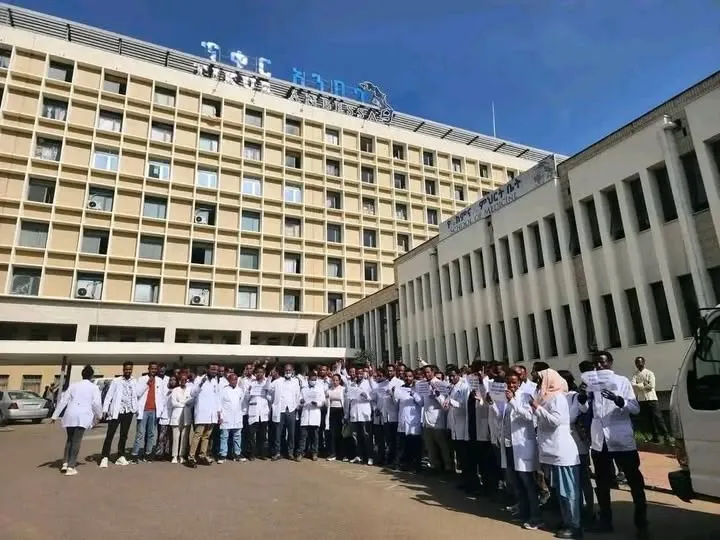
Health professionals across Ethiopia have commenced a partial strike following what they say is the government’s failure to respond to long-standing grievances over inadequate salaries, poor working conditions, and systemic neglect of the health sector. The workers had issued a 30-day notice demanding urgent reforms, but after receiving no formal reply, they began to withdraw services in most medical departments starting May 13, 2025.
Speaking to the BBC, five health professionals from different regions confirmed that only a limited number of critical units—namely emergency services, maternity wards, intensive care units, and emergency surgeries—remain operational. All other services, including outpatient care, non-urgent surgeries, and general inpatient wards, have ceased functioning in many hospitals.
The impact of the strike is particularly pronounced in Ethiopia’s largest referral and teaching hospitals, including Tikur Anbesa (Black Lion), St. Paul’s, ALERT, Felege Hiwot, Tibebe Ghion, Gondar University Hospital, Addis Zemen, and Hawassa University Hospital. These institutions serve as vital medical hubs for millions across the country.
At Tikur Anbesa Hospital, widely regarded as Ethiopia’s foremost medical facility, a doctor who requested anonymity revealed that nearly half of all wards have been closed. “We are no longer able to work in non-critical departments,” he said. “Doctors have simply stopped showing up. Nearly 40 percent of the staff have walked out.”
In Hawassa, another major referral hospital in the south, a senior doctor confirmed that “the entire workforce outside emergency care is on strike. Outpatient services, routine surgeries, and inpatient admissions are all shut down.”
Hospital officials have corroborated these reports, with one administrator acknowledging that attendance by medical interns and residents has dropped to virtually zero. At Tibebe Ghion Hospital in Bahir Dar—Amhara region’s largest facility—approximately 95 percent of health workers are participating in the strike.
Striking workers say their decision to walk out did not come lightly. “We’ve served to the limits of our strength,” said one professional. “We are not demanding luxuries. We are struggling to survive.”
One of the strike coordinators described the action as both necessary and strategic. “The partial strike is being implemented as planned. Many of the country’s hospitals are now only offering emergency care.”
However, the disruption is beginning to affect patients. Hawassa University Teaching Hospital, a key referral center for several southern and Oromia regions, is already experiencing severe backlogs. A hospital administrator said, “Patients are being turned away. Many will go unseen.”
For striking health workers, the goal is not merely financial. They frame the strike as a moral protest aimed at saving a collapsing system. “I never took an oath to serve while starving, while in pain, unable to provide for my children,” said a specialist at Tikur Anbesa. “If patients are left untreated, it’s the government that holds the responsibility, not us.”
Another doctor emphasized that the strike is a last resort. “We did not choose this path willingly. It’s the government’s silence that pushed us here. We’ve been ignored long enough.”
Reports also indicate increasing retaliation against medical professionals participating in the movement. A doctor at Tikur Anbesa disclosed that the salaries of 11 recently graduated doctors have been withheld, and at least six senior physicians have received verbal warnings. “Rather than open a dialogue, authorities are using threats and coercion,” he said.
As the March 10 deadline for a full strike looms, movement leaders remain skeptical that the government will intervene in time. While some hospital officials hinted that consultations might take place in the coming days, no official invitation has been extended to the striking professionals.
In response to the growing crisis, several health institutions have issued internal directives warning employees to resume work immediately. Yet, the professionals insist that their demands remain unmet and that the partial strike will continue.
Adding to the tension, reports have emerged of union leaders and health workers being detained by security forces over the past week. Although some have since been released on bail, human rights groups like Amnesty International are calling for the immediate release of all detained medical personnel.
On Monday evening, Health Minister Dr. Mekdes Daba appeared on national television, stating that the government is working to address the concerns of health professionals. However, for many on the ground, those assurances have come too late—and without action, the partial strike may escalate into a full-blown national health crisis.

About Addis Insight
Addis Insight is Ethiopia’s fastest growing digital news platform, providing consumers with the latest news from Ethiopia and its diaspora. We provide marketers with innovative opportunities to leverage our stories and overall brand with a fiercely curious and highly engaged audience.