Yeka Hills Transformed—But at What Human, Ecological and Economic Cost?

The Yeka Hills Transformation
A geospatial and developmental analysis of Addis Ababa’s Chaka Project—an emblem of ambition, a magnet for capital, and a test of governance.
Executive summary
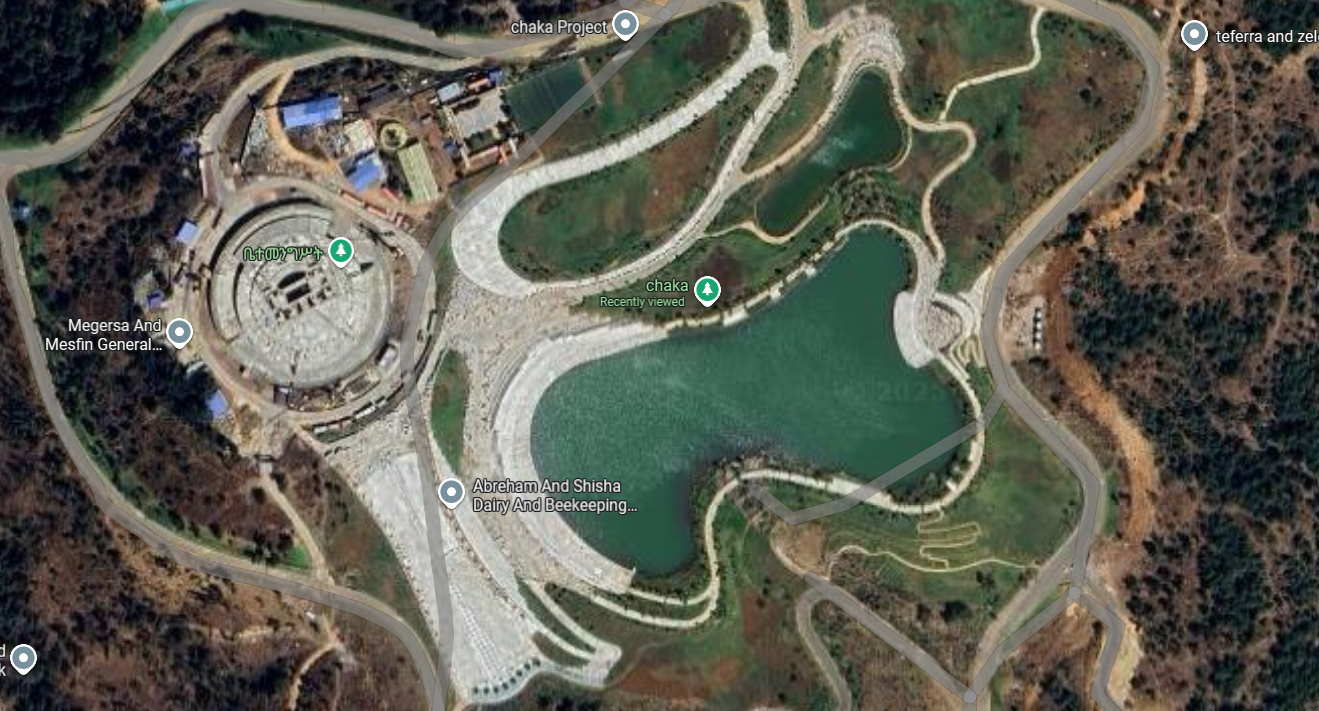
Few urban projects in Africa match the velocity and spectacle of the Chaka Project in Addis Ababa’s Yeka Hills. Presented as a 503-hectare smart satellite city designed to decongest the capital, Chaka fuses a new national palace complex with premium housing, hospitality and retail, three artificial lakes and roughly 29 kilometres of new roads. It is positioned as the architectural anchor of a wider city-corridor programme that promises better pavements, bike lanes, tree-lined boulevards and upgraded utilities. The price tag is heavily disputed, the timeline ambitious and the governance model opaque. Yet the project’s momentum is unmistakable: satellite-visible earthworks, terraced platforms across escarpments and the outlines of a new urban grid cut into what was, until recently, one of Addis Ababa’s green lungs.
This article treats Chaka as a case study in megaproject political economy. It examines the stated vision and the embedded corridor strategy; deconstructs the master plan and stakeholder map; reconstructs the landscape transformation using time-series imagery; evaluates financing scenarios and their macro-signals; and weighs the social and environmental ledger. The core conclusion is double-edged: Chaka showcases state capacity to mobilise contractors and alter terrain at speed, but its long-term legitimacy will hinge on transparency, mitigation of ecological loss and credible public dividends beyond the palatial slopes.
What Chaka is—and what it is not
To its champions, Chaka is a keystone of a new urban order: a planned, elegant satellite city that contrasts with the capital’s improvisational sprawl. The flagship palace complex is flanked by gated residential districts, hospitality, retail and civic spaces. Communications emphasise modern boulevards, bike lanes, digital connectivity and a “green” urbanism meant to signal a break with the past.
Yet Chaka is not, at least officially, a standalone palace project. It has been consciously tethered to the Addis Ababa City Corridor—sometimes branded as the Smart City programme—that upgrades axes across the metropolis. One corridor explicitly links Chaka’s South Gate to Megenagna, Haya Hulet and Meskel Square over roughly seven kilometres, increasing the project’s political salience by tying elite architecture to public-realm improvements.
Anatomy of the plan
The footprint—just over 503 hectares—rivals entire historic complexes elsewhere. Within it, the master plan assigns roles with corporate precision. A state contractor leads the palace package. A major Chinese builder is associated with the marquee hotel. The roads authority is extending a 29-kilometre grid through escarpment terrain. Private Ethiopian developers—most visibly the Ovid Group—carry large housing tranches marketed as high-amenity living within a “forest sanctuary” aesthetic.
| Component | What’s planned | Reported actor |
|---|---|---|
| National Palace | Executive compound atop Yeka slopes | State contractor |
| Sky View Hotel | VIP hotel & guesthouses | CCECC |
| Housing (Phase) | >4,100 units signed; ~1,900 by Ovid in a 9-ha parcel | Ovid Group; ICE Housing |
| Roads | ~29 km of new internal and external links | Roads Administration |
| Water features | Three artificial lakes | Project contractors |
Geospatial evidence: a landscape remade
Prior to 2022, the Yeka Hills read as a high-elevation green lung—eucalyptus stands, footpaths, church trails, and informal recreation areas above CMC and Megenagna. City planning documents described much of it as multi-functional forest, even as encroachment grew. Since the project’s launch, a phased metamorphosis is visible: rapid canopy clearance; bulk earthworks and terracing; vertical construction; and the imposition of a gridded road hierarchy. The artificial lakes appear as vast bowls cut into former slopes. Security perimeters, access control and a monumental entrance ensemble have followed.
Finance and the political economy of megaprojects
Chaka and its allied corridors are marketed as self-financing: a patchwork of public-private partnerships, domestic and international donations, and developer capital. In practice, the public contribution is substantial even without line-item treasury spending. Land is state-owned and has been allocated at scale—503 hectares that, under market conditions, would carry extraordinary valuations. Utilities, trunk roads, perimeter security and reputational guarantees come via public agencies. Developers typically post equity slivers and raise bank debt against pre-sales; the state carries political risk and the opportunity cost of land.
External money matters. Gulf capital is widely believed to be influential; diaspora flows are another pillar. The donation model is hotly debated. However structured, the mix allows the government to claim minimal budgetary outlay while the public balance sheet shoulders indirect costs. The upside is speed: a mechanism to marshal large contractors and keep cash flowing even as macro headwinds bite. The downside is opacity: blurred lines between public goods and elite amenities, and few audited milestones that citizens can use to assess value for money.
The corridor wrapper is politically savvy. By attaching Chaka to a city-wide programme of pavements, libraries, parks and bike lanes, officials shift the narrative from a palace on a hill to a mobility and public-realm upgrade for the metropolis. One spine runs from Chaka’s South Gate through Megenagna and Haya Hulet to Meskel Square—symbolically and practically binding the enclave to the civic core.
Winners, losers and the social ledger
For high-income households and the diaspora, the promise is clear: premium housing with proximity to state power, commanding views and new infrastructure. A flagship private developer markets roughly 1,900 apartments across a nine-hectare parcel with retail and amenities; other firms have signed for adjacent phases. Hospitality operators anticipate diplomatic and investor traffic once the palace and lakeside promenades open. Retail and property management will add jobs and tax receipts if occupancy is strong.
But the opportunity cost is borne nearby. Evictions associated with corridor clearances, demolition of fragile housing and the tightening of access have raised the political temperature. Runners who trained on the slopes, picnickers and pilgrims bound for historic hilltop churches have watched public space shrink behind perimeter fencing and checkpoints. Ethiopia’s land tenure regime makes repossession legally straightforward; that does not make it painless. Long-term legitimacy will depend on compensation that is timely and adequate, credible relocation options, and sustained investment in accessible parks elsewhere to offset the green deficit.
Information scarcity and the misinformation boom
With few official master plans in circulation and sporadic updates, the information market has been cornered by glossy renders—many not even Ethiopian. Fact-checking groups have repeatedly debunked viral images that misattribute foreign projects to Chaka, from Central Asian bridges to Mexican “forest cities”. The dynamic is circular: opacity invites rumour; rumour muddies accountability; the cycle repeats. Clear communication—floor-by-floor progress, monthly budgets, environmental baselines—would reduce the incentive to fill the vacuum with speculation.
Construction status and the near horizon
Public videos and trade chatter suggest the entrance ensemble and primary boulevard are well advanced; lake basins are shaped; residential shells are rising in phases; and the new road network is visible from arterial approaches. Contracts publicised in mid-2025 cite a substantial housing tranche for more than 4,100 units, with a 2026 date often floated for selected completions. The broader corridor programme’s target is 2025, though megaproject timelines typically slip. The near-term question is not whether the palace opens, but whether the surrounding city components—transport interfaces, parks, drainage—arrive at the same cadence.
Economic significance: signal, magnet and risk
Urban megaprojects do as much with symbolism as with cement. For Ethiopia, Chaka signals a pivot from austerity to aspiration, intended to reassure investors that state capacity and political will can marshal capital, bend terrain and deliver at speed. The palace’s prominence underscores regime durability; the corridor wrapper suggests a city learning to design public space as a system rather than an afterthought. If the imagery holds, Addis could market a new skyline, lakefront promenades and premium addresses to a diaspora that has long invested in low-yield plots and mid-rise shells.
But magnets can repel. High-end supply in an economy with limited middle-class depth risks vacancy or speculative churn. If financing leans on pre-sales to a narrow buyer pool, developer cashflows will be sensitive to exchange-rate stress, remittance cycles and political headlines. The fiscal optics matter: even indirect subsidies bite when budgets tighten, and public patience can sour if promised social dividends—a safer, greener, more mobile city—arrive slower than walls rise in Yeka. For the project to escape the “enclave trap,” corridor benefits must be tangible: buses that run on time, crossings that protect pedestrians, and pavements continuous enough to matter.
Governance tests that will decide the legacy
Transparency
Publish reliable, consolidated budgets and staged scopes; standardise how PPP obligations—land valuations, utility extensions, security—are accounted for. Sunlight would cool a fevered rumour market and make it easier to judge success against original intent. Open data on monthly progress, procurement and change orders should be the default, not the exception.
Environmental stewardship
Replace rhetoric with measured baselines and targets: canopy restoration offsite to compensate for losses, runoff management for newly impervious surfaces, lake water-balance disclosures, and biodiversity corridors that are more than rendered greens. A “forest city” must contend with the forest it replaced. Urban heat-island effects on the escarpment should be modelled and mitigated through albedo choices, shade trees and water-sensitive design.
Social contract
Where relocation is unavoidable, document compensation and rehousing in the open, at speed. Keep corridors genuinely civic: pavements continuous, crossings safe, and public transport reliable. Gateways to palaces should not become walls for neighbourhoods. Community amenities—clinics, schools, markets—ought to be front-loaded rather than promised for later phases.
Bottom line
Chaka is many things at once: a theatre of state power; a testbed for corridor-led urbanism; a property play riding on diaspora cash; a construction campaign that has swapped trees for terraces; and a communications challenge the authorities have, so far, struggled to meet. If delivery is paired with transparency, if the corridors function for ordinary commuters, and if ecological losses are offset with measurable gains, Yeka’s engineered vistas may yet become an asset rather than a grievance. If not, the palatial slopes will stand as a monument to a heady phase of ambition—grand from afar, contested up close.
Appendix: feature graphic (hero)

About Addis Insight
Addis Insight is Ethiopia’s fastest growing digital news platform, providing consumers with the latest news from Ethiopia and its diaspora. We provide marketers with innovative opportunities to leverage our stories and overall brand with a fiercely curious and highly engaged audience.