Inside Ethiopia’s Modern Air Fleet: What Was Revealed at the 90th Anniversary Show

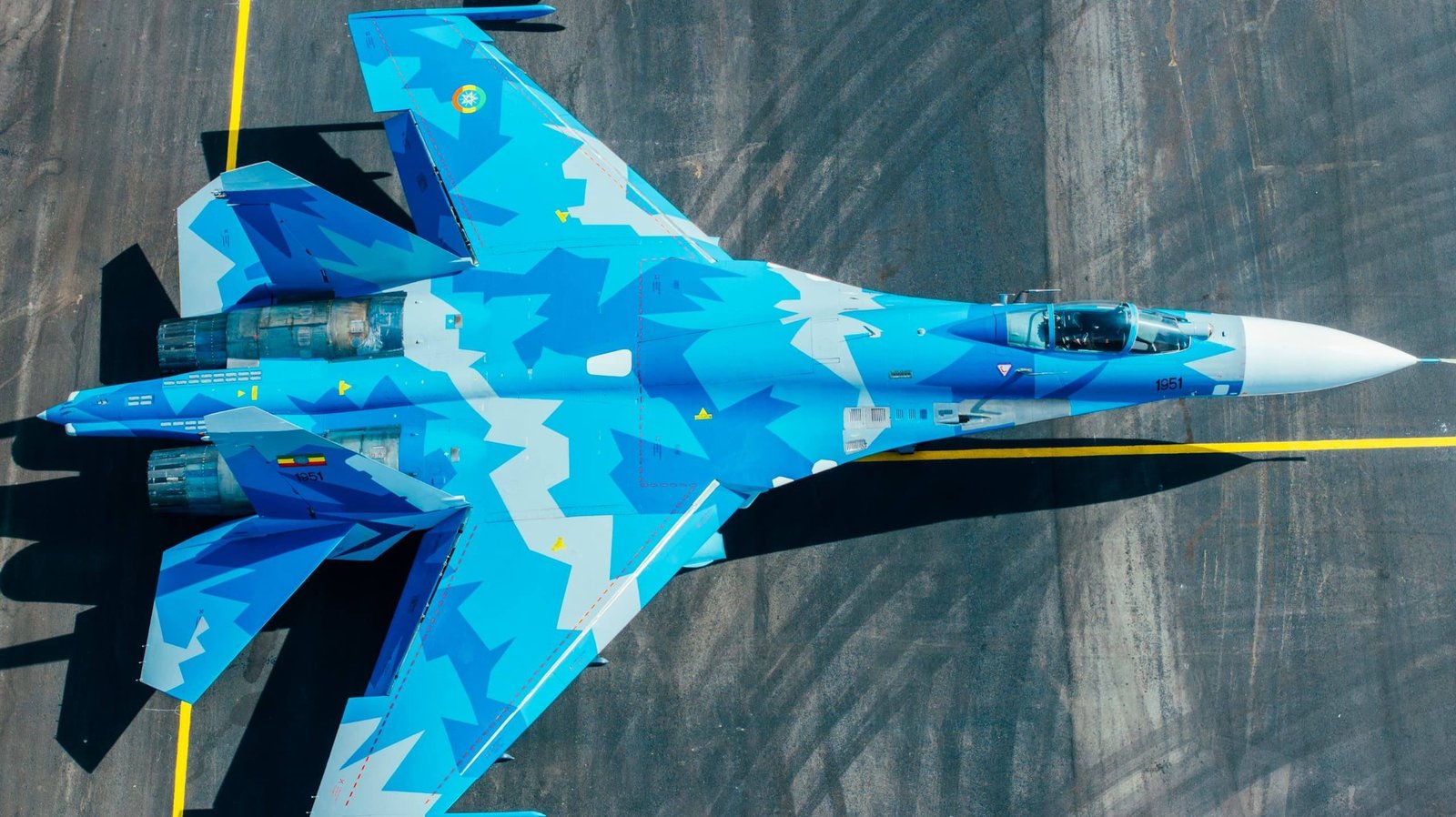
When the Ethiopian Air Force marked the 90th anniversary of its formation with a rare public air show—branded the Black Lion display—the spectacle was not merely ceremonial. It was a carefully choreographed signal: Ethiopia intends to reassert itself as a serious air power in the Horn of Africa, at a time when regional security competition, drone warfare, and great-power rivalry are intensifying.
The aircraft on display—some confirmed, others observed but not officially acknowledged—offered a revealing snapshot of Addis Ababa’s evolving military doctrine: fewer platforms, higher capability, and a decisive tilt toward advanced Russian systems.
A Force Rebuilt for the Post-Insurgency Era
Founded in 1935, the Ethiopian Air Force is Africa’s oldest. Yet for much of the past decade, it operated under the strain of internal conflict, sanctions pressure, and constrained procurement channels. The anniversary event therefore served a dual purpose: celebrating institutional longevity while showcasing what officials described as renewed operational readiness.
The emphasis was unmistakably on modernization rather than scale—a shift from Cold War–era quantity toward networked, high-performance assets capable of air superiority, surveillance, and precision strike.
Sukhoi Fighters: Air Superiority as a Strategic Statement
The most closely watched appearance at the show was that of Russian-made Sukhoi fighter jets, long a backbone of Ethiopia’s air combat fleet. Observers, however, noted something new: what appeared to be the Su-35 Flanker-E, a fourth-generation-plus multirole fighter rarely seen in Africa.
The Su-35, if indeed operational, would represent a qualitative leap. It features:
- Advanced phased-array radar systems
- Thrust-vectoring engines for extreme maneuverability
- Integrated electronic warfare suites
- Reduced radar signature compared to earlier Sukhoi variants
Reports have circulated that Ethiopia has agreed to acquire up to eight Su-35 aircraft, though no official confirmation has been issued. If true, Ethiopia would join a very small group of non-NATO operators fielding this class of aircraft—underscoring its ambition to dominate regional airspace rather than merely defend it.
Yak-130: Training, Simulation, and Light Combat
Also spotted during the display was a Yak-130 advanced jet trainer, bearing tail number 2303. While authorities stopped short of confirming its induction, its presence was significant.
The Yak-130 occupies a strategic niche. It can:
- Simulate fourth- and fifth-generation fighters, including the Su-57
- Train pilots transitioning to high-performance combat aircraft
- Carry up to 3,000 kg of payload for light attack and close air support
For an air force expanding into more complex platforms, the Yak-130 is less about firepower than human capital—ensuring pilots are prepared for increasingly sophisticated aircraft without the cost of flying frontline jets.
Orion-E Drone: Ethiopia Enters the MALE Class
Perhaps the clearest confirmation of modernization came in unmanned aviation. Ethiopia has been acknowledged as the first foreign operator of Russia’s Orion-E MALE (Medium Altitude, Long Endurance) drone.
The system dramatically enhances Ethiopia’s capabilities in:
- Persistent surveillance and reconnaissance
- Precision strikes using guided munitions
- Close air support in complex terrain
With endurance reportedly exceeding 24 hours, the Orion-E reflects a doctrinal shift shaped by recent conflicts—where drones have proven decisive in intelligence dominance and asymmetric warfare. For Ethiopia, it offers reach without escalation, persistence without pilot risk.
Looking Ahead: Fifth-Generation Ambitions
The most forward-looking statement came not from the tarmac but the podium. Prime Minister Abiy Ahmed announced plans to acquire fifth-generation fighter jets by 2030, alongside an ambition to double the current air fleet.
Such aircraft—characterized by stealth, sensor fusion, and network-centric warfare—would place Ethiopia in unprecedented territory on the continent. Whether this goal proves realistic will depend on financing, geopolitics, and training capacity. But the intent itself is telling: Ethiopia sees air power not as auxiliary, but as central to national defense and regional influence.
More Than a Show
The Black Lion air display was not about nostalgia. It was a strategic communiqué—to neighbors, partners, and rivals alike. Ethiopia is repositioning its air force for a world where control of the sky increasingly determines outcomes on the ground.
In an era of drones, electronic warfare, and precision strike, Addis Ababa appears determined not to lag behind—but to compete. Whether ambition translates into sustained capability will be the true test in the decade ahead.

About Addis Insight
Addis Insight is Ethiopia’s fastest growing digital news platform, providing consumers with the latest news from Ethiopia and its diaspora. We provide marketers with innovative opportunities to leverage our stories and overall brand with a fiercely curious and highly engaged audience.