Can Ethiopia Win the 2028 AFCON Bid? Inside the Nation’s Ambitious Stadium and Infrastructure Surge

The formal submission of Ethiopia’s bid to host the 2028 Africa Cup of Nations (AFCON) represents a definitive intersection of sporting ambition and a multi-dimensional national development agenda. This move, finalized by the Ethiopian Football Federation (EFF) on January 2, 2026, marks a significant acceleration of the country’s previous objective to host the 2029 edition. The strategic redirection was necessitated by a fundamental shift in the Confederation of African Football (CAF) scheduling, which, in December 2025, resolved to return the tournament to a four-year cycle and a quadrennial format beginning in 2028. This analysis evaluates Ethiopia’s candidacy by scrutinizing its macroeconomic stability, the status of its flagship and regional stadium projects, the supporting urban and logistical infrastructure, and the formidable challenges posed by rival bidders within the context of continental football politics and regional security.
The Strategic Realignment and National Context
Ethiopia’s decision to pursue the 2028 hosting rights is not merely a footballing endeavor but a centerpiece of the government’s efforts to leverage sports diplomacy for economic revitalization and international repositioning. The EFF, supported by high-level government guarantees, transitioned its focus from the 2029 target to 2028 to align with the first edition of the new quadrennial cycle. This shift reflects a belief within the administration of Prime Minister Abiy Ahmed that the ongoing “Homegrown Economic Reform” (HGER) will have sufficiently matured by 2028 to support an event of this magnitude.
The bid is grounded in Ethiopia’s historical legacy as one of the three founding members of CAF. Having previously hosted the tournament in 1962, 1968, and 1976, the nation seeks to end a half-century hiatus from the continental spotlight. The “winning” potential of this bid, however, depends heavily on the successful execution of the national sports development plan launched in 2023, which aims to modernize infrastructure across diverse sporting disciplines.
Macroeconomic Foundation and Fiscal Viability
The feasibility of the Ethiopian bid is inextricably linked to the country’s current fiscal trajectory. As of January 2026, Ethiopia is balancing complex debt restructuring with a rigorous IMF-backed reform program. The agreement in principle with Eurobond holders in December 2025—which included a 15% “haircut” on the $1 billion bond maturing in 2024—reduced the principal to $850 million, providing crucial breathing room for public investment. Furthermore, the introduction of a Value Recovery Instrument (VRI) signals investor confidence in Ethiopia’s export forecasts, suggesting that the nation may be in a stronger position to fund the final stages of AFCON preparations after 2026.
| Economic Metric (January 2026) | Status/Projected Value | Implication for 2028 AFCON |
| GDP Growth (Q3 2025) | 0.5% (expansionary) | Sustains momentum for public infrastructure projects.13 |
| Inflation Rate | ~9.8% (declining from 11%) | Eases the cost of local labor and materials for stadium construction.12 |
| Central Bank Policy Rate | 15% | Reflects monetary tightening to stabilize the Birr.12 |
| Foreign Reserve Accumulation | Stronger (IMF supported) | Enhances the ability to import specialized stadium technologies.8 |
| Exchange Rate | 154 ETB/USD (official) | Market-determined rate transition aids transparent budgeting.7 |
The successful completion of the fourth review under the Extended Credit Facility (ECF) in January 2026 allowed Ethiopia to draw approximately $261 million, reinforcing the fiscal framework required for large-scale projects like the Adey Abeba Stadium. However, the persistence of a fractured foreign exchange market, where black market rates reach 181 ETB/USD, remains a risk for private sector contractors involved in the tourism and hospitality sectors.
Stadium Infrastructure: A National Resurgence
The most scrutinized aspect of the Ethiopian bid is its current lack of a CAF-accredited stadium capable of hosting senior international fixtures. To rectify this, the government has allocated over 14 billion Birr for the completion and renovation of 13 stadium projects nationwide, with a focused effort on six key venues identified as potential AFCON host sites.
Adey Abeba International Stadium (Addis Ababa)
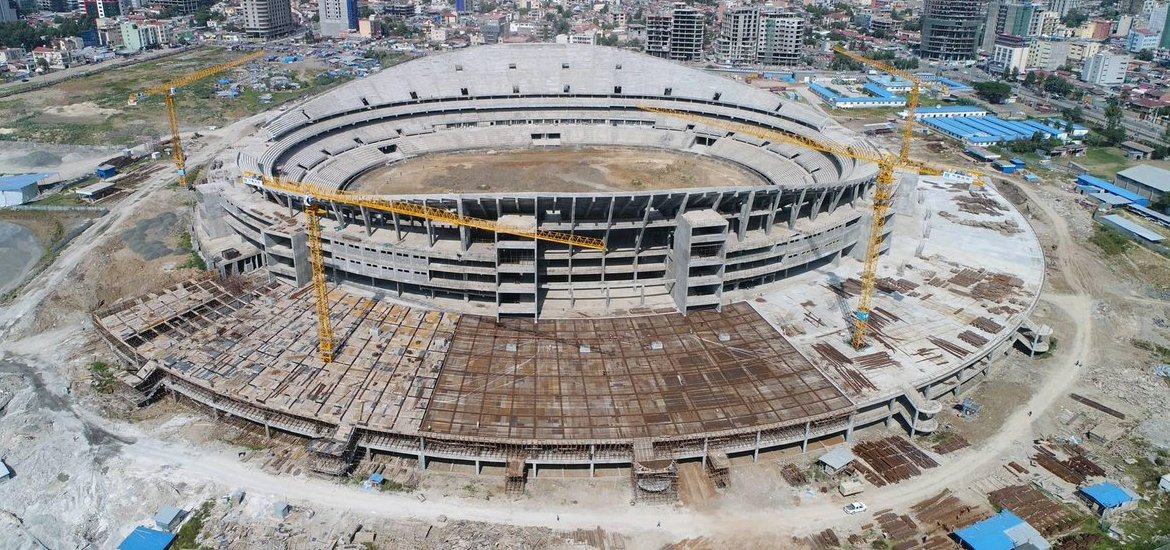
As the crown jewel of the bid, the 62,000-seat Adey Abeba International Stadium is designed to meet Category 4 CAF and FIFA standards. By mid-January 2026, the project achieved a landmark technical milestone when its pitch received official FIFA Quality Certification with a technical score of 86%. The construction, managed by the China Communications Construction Company (CCCC), is currently in its final and most expensive phase: the installation of the “Massob” inspired roof.
The stadium is not an isolated project but the anchor of the $1.2 billion “Bole Corridor” urban renewal initiative. This integration ensures that the venue is supported by modern amenities, including 1,200 restrooms, premium spectator seating, and proximity to a burgeoning hub of five-star hotels. The urgency of its completion is driven not only by the AFCON bid but also by Ethiopia’s selection to host the COP32 summit, which will serve as a “stress test” for the facility’s logistical capacity.
Bahir Dar International Stadium
Located in the Amhara region, the Bahir Dar Stadium is a 52,000-capacity venue that has undergone significant reconstruction since being suspended by CAF in October 2021. The 2.2 billion Birr renovation project, a collaboration between the federal government, the Amhara regional state, and private contractors like MIDROC and Gregori International, is targeted for full completion by late 2026.
| Feature of Bahir Dar Stadium | Status (2025-2026) | Goal for 2028 Bid |
| Seating Installation | Completed | 52,000 modern seats with clear sightlines. |
| Turf and Pitch | Natural turf renovation complete | Achieve FIFA Quality Pro status. |
| Lighting System | Rapidly developing | Meet CAF Category 4 broadcast requirements. |
| Medical and Media Facilities | Under construction | Rectify previous CAF non-compliance issues. |
The proximity of the stadium to the Tana shore and the construction of the Fellege Ghion Resort are intended to transform Bahir Dar into a tourism-centric host city, diversifying the tournament’s geographic footprint.
Dire Dawa, Hawassa, and Regional Venues
The Dire Dawa International Stadium has emerged as a functional success story within the bid. It currently features a FIFA-certified artificial turf pitch and has been expanded to 25,000 seats. Experts have noted the pitch’s quality as comparable to elite European venues, and it began hosting Ethiopian Premier League matches in February 2024 as a test of its operational readiness.
Hawassa Stadium, with a capacity of 42,000, was reported to be 96% complete in late 2021, though it has required additional budgetary allocations (approximately 1.8 billion Birr) for final facility upgrades to meet CAF’s evolving standards. Other regional projects in Jimma and Mekele are being leveraged as catalysts for sports-led urban investment, though the latter faces challenges due to regional security dynamics.
Technical Compliance: CAF Hosting Mandates
To secure the bid, Ethiopia must strictly adhere to the requirements for a 24-team tournament. These regulations encompass not only stadium capacity but also specialized infrastructure for teams, officials, and media.
Stadium and Training Requirements
CAF mandates a minimum of six stadiums for the final tournament. The distribution must include at least two venues with 40,000+ capacity, two with 20,000+, and two with 15,000+. Ethiopia’s current portfolio—Adey Abeba (62,000), Bahir Dar (52,000), and Hawassa (42,000)—comfortably satisfies the large-capacity requirements, while Dire Dawa (25,000) and the projected upgrades in Jimma and Mekele address the mid-tier and smaller venue needs.
| Facility Type | Requirement | Ethiopia’s Readiness (2026) |
| Pitch Dimensions | 100m–110m length / 64m–75m width | Adey Abeba and Dire Dawa meet/exceed.24 |
| Medical Rooms | Specialized rooms with AEDs, ventilators, and oxygen | Integrated into new designs for Adey Abeba and Bahir Dar.21 |
| Doping Control | TV, fridge, non-alcoholic drinks, seating for 8 | Standardized in the “Massob” construction phase.24 |
| Team Facilities | Dressing rooms for 25 people with 5 showers/toilets | Part of the ongoing 14 billion Birr renovation push.14 |
| Training Pitches | Natural or FIFA-licensed artificial turf | Bahir Dar and Adey Abeba include multiple annex pitches.19 |
The ban on temporary stands means that Ethiopia’s investment must be in permanent, high-quality structures, reinforcing the long-term legacy of the bid but increasing the immediate financial burden.
Media and VIP Logistics
Modern AFCON editions require extensive media facilities, including covered commentary positions and high-definition LED screens. The Prince Moulay Abdellah Stadium in Morocco, which set the standard during the 2025 edition, features smart crowd management and solar energy sources—technologies that Ethiopia is attempting to replicate in the Adey Abeba project through the integration of solar panels and advanced acoustic systems.
Urban Infrastructure and Connectivity
Infrastructure beyond the stadium perimeter is often the deciding factor in CAF evaluations. This includes airport capacity, intercity road and rail networks, and the availability of five-star hospitality.
Aviation and Intercity Mobility
Ethiopian Airlines, as a continental symbol of excellence, provides the bid with a “logistical sovereignty” that few other candidates can match. However, the reliance on air travel for internal movement is a potential weakness. Experts argue that domestic air travel is ill-suited to the socio-economic realities of a mass-attendance tournament, advocating for the expansion of the rail network.
- Road Connectivity: The Modjo-Hawassa Expressway, a 202-kilometer project, has reduced travel time by 40%, cutting the journey from Addis Ababa to the Hawassa host city from five hours to three.
- Urban Corridors: The corridor development initiative has expanded to dozens of cities, including Bahir Dar and Gondar, where over 32 km of roads and pedestrian paths have been built to improve match-day mobility.
- Logistics Hubs: The Modjo-Hawassa corridor serves as part of the Cairo-Cape Town Trans-African Highway, enhancing Ethiopia’s capacity to handle regional fan influxes from Kenya and the wider East African region.
Hospitality Capacity and the “Hotel Crunch”
While Addis Ababa leads East Africa in hotel development, accounting for 86% of Ethiopia’s pipeline, there remains a significant gap in the regional cities. A 2025 assessment indicated that for a major international event, Addis Ababa might face a “hotel crunch” for official delegations, as five-star capacity is concentrated in a few anchors like the Ethiopian Skylight, Sheraton, and Hyatt Regency.
| City | Hospitality Status (2026) | Strategic Mitigation |
| Addis Ababa | ~5,000 rooms in 25 hotels | Expansion of Airbnb supply (66% 1-2 bedroom units).43 |
| Bahir Dar | Regional properties (Protea, Four Points) | Development of Gorgora-style eco-resorts.20 |
| Hawassa | Growing industrial-tourism hub | Leveraging capacity from the Hawassa Industrial Park proximity.20 |
| Dire Dawa | Limited high-end capacity | Focus on 3-star upgrades and city beautification.26 |
The government’s incentives for private sector investment in the hospitality sector are aimed at diversifying accommodation options beyond the capital, which is essential to meet CAF’s requirement for high-quality lodging in every host city.
Security, Stability, and Geopolitical Risk
The most significant non-technical challenge to the Ethiopian bid is the prevailing security situation in the northern and regional states. As of January 2026, the security landscape remains dynamic, with potential implications for international tourism and event insurance.
The Tigray and Amhara Dynamics
Renewed clashes between federal forces and Tigrayan fighters in late January 2026 resulted in the suspension of flights to Mekelle and Axum, signaling that the peace agreement remains fragile. For a host city like Bahir Dar, which is located in the Amhara region, civil unrest or kidnapping threats in surrounding areas could trigger negative travel advisories from participating nations.
The “optical” risk of hosting a continental festival while humanitarian needs remain high in northern regions is a factor that CAF officials will likely weigh. To win, Ethiopia must demonstrate that its “security preparedness” is robust, including crowd management protocols and collaboration with international law enforcement agencies.
Sports Diplomacy as a Stabilizer
Conversely, the Ethiopian government views the AFCON bid as a tool for “soft power” and national reconciliation. By distributing matches across diverse regions—from the eastern trade hub of Dire Dawa to the southern industrial centers and northern cultural sites—the state aims to project an image of a unified and resilient nation. This narrative of “resurgence” is supported by the recent successes of Ethiopian athletes on the global stage, which have boosted national pride and interest in grassroots sports development.
Comparative Analysis: Rival Bidders and Continental Politics
Ethiopia’s bid does not exist in a vacuum. The competition for the 2028 edition is intense, featuring established hosts and sophisticated regional partnerships.
The BONASA Bid (Botswana, Namibia, South Africa)
The most formidable regional challenge comes from the BONASA (Botswana, Namibia, South Africa) joint bid.1 This proposal leverages South Africa’s world-class infrastructure, including 13 stadiums already approved by CAF for the 2025/2026 season.36
| Feature | Ethiopia’s Bid | BONASA Bid |
| Stadium Readiness | Moderate (Ongoing construction) | High (Existing WC 2010 venues).5 |
| Hosting Experience | Historical (last in 1976) | Recent (SA hosted in 1996, 2013).54 |
| Regional Integration | Solo (East African hub) | SADC Regional (Three-nation partnership).36 |
| Economic Buffer | IMF-backed reform | Diverse regional economies (SA/Botswana).13 |
| Risk Profile | Internal security concerns | Economic fluctuations/Sovereign debt.13 |
The BONASA bid argues that Southern Africa has been neglected, with no AFCON hosted in the region since 2013.13 However, the partnership faces internal hurdles, including reports of poor communication between South African and Namibian officials and delays in upgrading Namibia’s Independence Stadium.58
North African Dominance: Morocco and Egypt
Morocco, the host of the 2025 edition, is increasingly viewed as a “saviour” for CAF events due to its unparalleled infrastructure and readiness. With the 115,000-seat Hassan II Stadium set for completion by 2029, Morocco’s technical dossier is superior to almost any other African nation. Egypt, too, remains a “perennial candidate,” having hosted in 2019 with world-class venues and transport links.
The principle of geographic rotation could work in Ethiopia’s favor, as North Africa (Egypt 2019, Morocco 2025) and West Africa (Ivory Coast 2023) have dominated the recent cycle. With East Africa hosting in 2027 (Pamoja bid: Kenya, Uganda, Tanzania), Ethiopia’s primary task is to prove it can offer a unique and secure alternative to the Southern African block.
The “Winning” Probability: A Strategic Synthesis
Can Ethiopia win the 2028 AFCON bid? The answer lies in the intersection of technical compliance and political timing.
Strengths and Opportunities
Ethiopia’s primary strength is the “clean slate” provided by its 14 billion Birr stadium overhaul. Unlike nations trying to maintain aging infrastructure, Ethiopia’s flagship venues are being built to the latest 2026 CAF specifications. The “Massob” design of the Adey Abeba Stadium offers a visually iconic centerpiece that appeals to the cultural branding requirements of a modern mega-event. Furthermore, the dominance of Ethiopian Airlines provides a logistical safety net for the movement of 24 teams and thousands of fans, a capability that few joint bids can guarantee with equal efficiency.
Weaknesses and Threats
The lack of any currently accredited stadium remains a severe technical liability.While the construction progress is significant, any delays in the “Massob” roof installation or Bahir Dar’s internal facility upgrades could lead to a negative inspection report in the 2026–2027 window. Additionally, the regional security flare-ups in January 2026 provide rival bidders with a “stability narrative” that may sway CAF’s executive committee, which prioritizes the safety of commercial partners and broadcast crews.
The Economic Gamble
The 19 billion Birr investment in the Adey Abeba project alone is a massive bet on the future. If successful, AFCON 2028 will act as a multiplier for Ethiopia’s tourism and logistics sectors, justifying the high-interest fiscal environment. If the bid fails, the government faces the risk of “white elephant” stadiums and a deepened debt burden, though officials remain optimistic that the infrastructure will serve the nation’s burgeoning sports culture regardless of the CAF decision.
Conclusions and Future Outlook
Ethiopia’s bid for the 2028 Africa Cup of Nations is a high-risk, high-reward strategy that reflects the nation’s “renaissance” narrative. The technical audit shows that the physical infrastructure—stadiums and expressways—is on a trajectory to meet CAF standards by the critical 2027 inspection period.14 However, the winning margin will likely depend on factors beyond the pitch: the consolidation of regional peace, the stabilization of the Birr, and the ability to convince CAF that East Africa is ready for consecutive hosting duties.
The comparison with the BONASA bid suggests that while Ethiopia may lag in “immediate readiness,” it offers a more concentrated and state-driven development model that could appeal to CAF’s desire for lasting legacy impact.13 As the February 1, 2026 deadline for official confirmation passes, the focus must shift to maintaining construction momentum and resolving regional tensions. For Ethiopia, the 2028 bid is not just about 52 matches over 30 days; it is about proving that the “Giant of Africa” has successfully navigated its most challenging decade to emerge as a capable host for the continent’s greatest spectacle.

About Addis Insight
Addis Insight is Ethiopia’s fastest growing digital news platform, providing consumers with the latest news from Ethiopia and its diaspora. We provide marketers with innovative opportunities to leverage our stories and overall brand with a fiercely curious and highly engaged audience.