
Keep Up with Addis Insight
Add us to your Google Preferred Sources to see updates first.
For many women in Ethiopia, the internet is no longer simply a space for communication, opportunity, or visibility. Increasingly, it has become a site of intimidation, surveillance, harassment, and gendered violence. As Ethiopia’s digital ecosystem rapidly expands, Technology Facilitated Gender Based Violence (TFGBV) is emerging as one of the country’s most urgent but underexamined threats to women’s participation in public, civic, and digital life.
Recent evidence from Voices Unmuted: Digital Safety and Resilience Hub report shows that TFGBV in Ethiopia is no longer isolated or incidental. The report describes online abuse against women as systemic, coordinated, and amplified through digital platforms, particularly targeting women who challenge patriarchal norms or maintain public visibility online. Women Human Rights Defenders (WHRDs), feminist advocates, journalists, content creators, and politically vocal women are among the most affected.
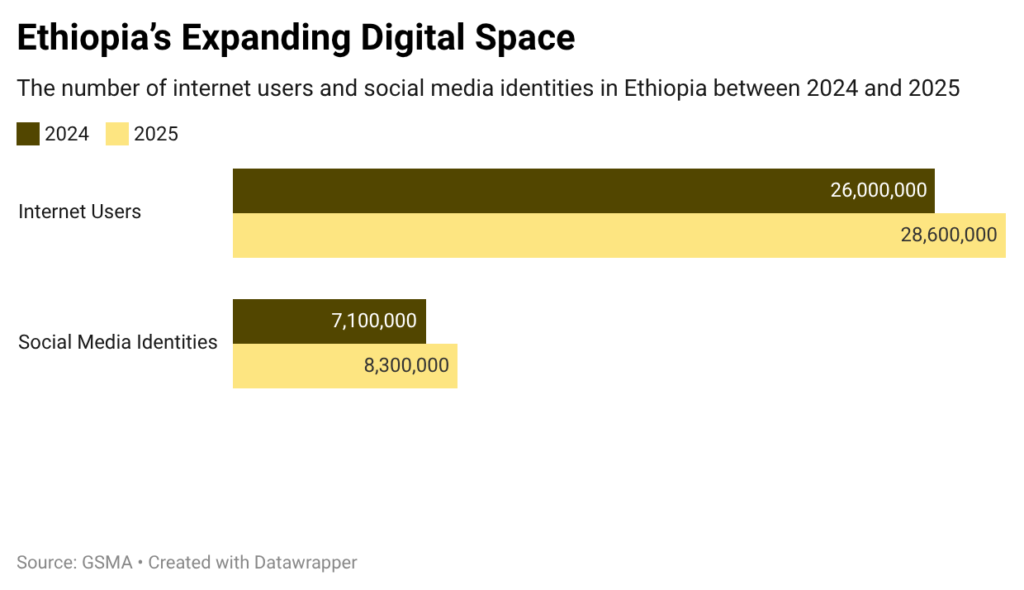
The rise of this violence parallels Ethiopia’s expanding digital landscape. Between 2024 and 2025, internet users in Ethiopia increased from 26 million to 28.6 million, while social media participation grew by 17.7 percent, reaching 8.3 million identities nationwide. As more political discussion, activism, journalism, and civic engagement move online, digital spaces are becoming central to public participation. Yet as access expands, so too does online abuse.
Women online increasingly face coordinated harassment, hate speech, cyberstalking, doxxing, sexualized threats, disinformation campaigns, and AI-generated deepfake abuse. What makes TFGBV particularly alarming in Ethiopia is the way violence travels across platforms. Abuse often begins on X, Facebook, YouTube or TikTok before escalating into less moderated and closed spaces such as Telegram, where threats, manipulated images, and targeted harassment circulate with little governance mechanism.
A six-month investigation by Shega Media published in December 2024 revealed how Telegram has increasingly become a hub for organized digital exploitation targeting mostly young women in Ethiopia. The investigation uncovered more than a dozen Telegram channels profiting from leaked intimate images and videos shared without consent. Some free channels reportedly had over 30,000 members and more than 7,000 leaked images and videos circulating across networks. Users were redirected into paid “VIP” channels where explicit content was monetized through subscription-style systems charging between 500 and 4,000 birr via legal digital payment services. This investigation shows how TFGBV in Ethiopia is evolving beyond individual harassment into an organized underground economy of abuse. Telegram’s private channel structures, encrypted systems, and weak moderation mechanisms make these networks difficult to monitor and regulate.
Another 2024 study by the Centre for Information Resilience (CIR), which analyzed thousands of social media posts alongside interviews with Ethiopian women in public life, found that women are routinely “silenced, shamed, and threatened” online. More than 78% of interviewed women reported experiencing fear and anxiety following online abuse, while many described withdrawing from public engagement altogether. The study further documented how online harassment frequently escalates into offline intimidation, reputational harm, physical threats, and forced relocation.
All these findings mirror broader African patterns documented by Pollicy study, which argues that digital violence against women cannot be separated from offline systems of patriarchy and structural inequality. Rather than functioning as equalizing spaces, digital platforms often reproduce the same discrimination women face offline. In Ethiopia, these attacks frequently intersect with politics, ethnicity, religion, and conservative gender norms, making abuse especially aggressive and deeply personal. Women interviewed across the reports described being attacked based on appearance, morality, ethnicity, religion, and political opinion. Feminist activists and women speaking publicly on gender equality were frequently accused of promoting “Western ideologies” or “foreign agendas,” accusations that carry significant social and political consequences within Ethiopia’s conservative environment. The result is a growing culture of self-censorship where women increasingly calculate the personal cost of visibility online.
Despite the growing scale of the problem, legal and institutional responses remain fragmented. Ethiopia’s 2016 Computer Crime Proclamation criminalizes certain forms of illegal digital content, including child pornography, but lacks clear provisions specifically addressing revenge porn and several forms of emerging TFGBV. The Anti-hate speech and misinformation proclamation also cannot address the growing rise of TFGBV threat. Technology platforms also continue struggling with local-language moderation in Amharic, Afaan Oromo, Af Somali, and Tigrigna, allowing harmful content to remain online longer while survivors encounter ineffective reporting systems and limited support mechanisms.
At the same time, Ethiopia’s rapid digital transformation continues to move faster than protections designed to safeguard women online. Without stronger intervention, expanding digital access risks reproducing existing gender inequalities through new technologies and platforms. Addressing TFGBV in Ethiopia therefore requires more than awareness campaigns alone. Stronger legal protections, specifically criminalizing different forms of TFGBV are urgently needed. Technology companies must invest in local-language moderation systems and faster survivor-centered reporting mechanisms. Digital literacy initiatives should also focus on online safety, consent, privacy, and the risks of digital exploitation, particularly among young people. Equally important is building survivor support systems that include mental health services, legal aid, and emergency response pathways for women facing coordinated online abuse.
Most importantly, TFGBV must be recognized not merely as a digital safety issue, but as a broader human rights and democratic concern. Women cannot participate equally in public discourse if visibility itself becomes dangerous. As Ethiopia’s civic, political, and social conversations increasingly move online, digital participation depends on whether women can engage safely without fear of harassment, exploitation, or violence.
This story was supported by Code for Africa’s WanaData initiative and the Digital Democracy Initiative as part of the Digitalise Youth project, funded by the European Partnership for Democracy (EPD) Code for Africa’s WanaData initiative

