
Keep Up with Addis Insight
Add us to your Google Preferred Sources to see updates first.
Women play a central role in the economy of Ethiopia, yet their participation remains unequal in both structure and outcomes. National and regional data reveal a striking paradox; while women are highly active economically, their contributions are invisible, unpaid, or undervalued. According to the 2025 gender brief by African Development Bank, women make up nearly half of the population and contribute significantly to economic activity, yet only 7.8% are engaged in paid employment, which underscores the imbalance between participation and reward. This gap is further reflected in Ethiopia’s economic gender index score of 0.542, signaling persistent disparities in access to income, resources, and opportunities.
At the household and community level, women’s economic engagement is both widespread and constrained. A large-scale national study covering 36,330 households found that 45.1% of women are engaged in productive employment (with or without additional domestic engagement), but the majority operate in self-employment or unpaid family work. At the same time, 41.3% of women are primarily engaged in domestic work, with activities such as cooking performed by as many as 82.5% of women. This unequal distribution of unpaid care work limits women’s ability to participate in formal and income-generating sectors, which leads them to cycles of economic dependency.
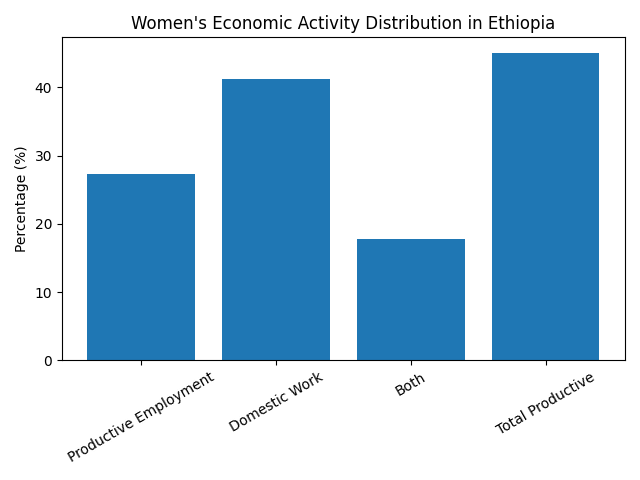
Source: Determining the Ethiopian Women’s Status & Priorities, 2024
Access to economic resources presents another layer of inequality. While 59.6% of women report owning residential housing and 40.4% own agricultural land, ownership is predominantly joint, and control remains limited. A substantial proportion of women are excluded from key financial and economic decisions: 33.1% cannot decide how to use their own income, and nearly a quarter have no say over how loans are spent. Financial inclusion remains low, with 57.3% of women lacking a bank account, which further constrains their economic independence. Thus, asset ownership does not necessarily translate into economic empowerment.
Barriers to women’s economic advancement are deeply rooted in structural and social factors. For many women in the business and informal sector, limited access to credit, training, and business development opportunities continues to restrict women’s entrepreneurial potential. At the same time, systemic challenges, such as a lack of irrigation and limited access to extension services, reduce productivity, particularly in rural areas. These constraints are compounded by broader economic shocks, with 60.3% of women reporting rising food prices as a major impact on their livelihoods.
Social norms and institutional gaps further shape women’s economic realities. Ethiopia’s predominantly patriarchal structure continues to assign women primary responsibility for unpaid care and domestic work, limiting their mobility and access to formal employment. Even where legal frameworks support gender equality, their implementation remains inconsistent, creating a disconnect between rights and outcomes. Conflict and instability in certain regions have also exacerbated these challenges, disrupting markets, increasing unemployment, and pushing more women into vulnerable forms of work.
Despite these constraints, there are signs of resilience and progress. Women’s participation in asset ownership, political representation, and certain sectors has improved over time. However, these gains remain uneven and insufficient to close the broader economic gap. The data consistently show that women are active economic agents, but operate within systems that limit their ability to benefit fully from their participation. Closing this gap requires more than increasing participation rates. It demands structural transformation, which includes expanding access to finance, reducing unpaid care burdens, strengthening institutional support systems, and ensuring that women not only participate in the economy, but also control and benefit from their contributions. Until then, women’s economic participation in Ethiopia will continue to be defined not by absence, but by inequality in opportunity, access, and reward.
This story was supported by Code for Africa’s WanaData initiative and the Digital Democracy Initiative as part of the Digitalise Youth project, funded by the European Partnership for Democracy (EPD) Code for Africa’s WanaData initiative

